

Will My Dx Lens Work On Fx Camera
The Future of FX
and DX Formats
© 2008 KenRockwell.com. All rights reserved.

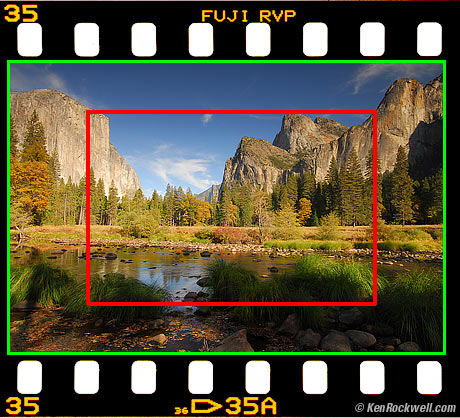
35mm film marked with Nikon sensor sizes.
( Light-green: FX, full-frame, Scarlet : Nikon DX. Encounter also Ingather Factor.)
I get my goodies at Ritz, Amazon and Adorama. Information technology helps me keep calculation to this site when y'all get yours from those links, as well.
July 2008 More than Nikon Reviews
Summary top
Nikon DX and Canon ane.6x formats are here to stay for a long fourth dimension for practically-priced cameras.
Nikon FX and Canon total-frame cameras will be expensive and e'er exist at the top of each maker'southward line for a long time. I see no hot deals in full-frame cameras for quite a while. FX cameras will always exist priced above anything else in smaller formats – that's just how marketing departments programme product lines.
I wouldn't postpone anything expecting to encounter cheap total-frame cameras anytime shortly. See too Obsolescence.
See Ingather Factor to understand what these formats mean.
History top
In the starting time, 35mm cameras shot odd-sized frames.
Nikon's first photographic camera, the Nikon I rangefinder of 1948, shot a 24 x 32mm frame. The 1949 Nikon Thousand shot in 24 x 34mm.
Nikon'southward first FX (24 x 36mm) photographic camera was the Nikon S2 rangefinder of 1954.
Ever since 1954, all Nikon's film cameras have shot in FX: 24 x 36mm. (I'k graciously forgetting the idiotic APS format, which I always told yous was stupid, while photo magazines of the era told you to buy them.)
In 1999 Nikon introduced the globe's first applied DSLR (see DSLR history), which for reasons of economic system and practicality, shot a diminutive (DX) sixteen x 24mm frame.
Dorsum in the early on days, when half-dozen megapixels was just science fiction, these tiny DX chips were a cracking style to permit smaller lenses and less expensive cameras. Nikon introduced a limited range of DX lenses which were smaller physically, but are not able to cover the larger moving picture or FX frame.
DX lenses were needed for wide angles and fisheyes, since even the widest and fishiest FX lenses weren't short plenty to be really wide or fishy on DX. DX lenses were never needed for normal or tele lenses. Conventional FX lenses piece of work perfectly on DX for that.
When sensors made information technology to ten MP, there started to be as well many pixels in too small a infinite for optimal quality. 10 MP cameras like the D200 were very demanding of lens performance, and considering each pixel was so small, nerveless less light and thus had less sensitivity, which lead to more noise when pushed to same ISO as a larger sensor, or the aforementioned sized sensor with fewer pixels.
Equally resolution increased, Canon started making a practical 11MP FX format digital SLR in 2002, while Nikon nevertheless tried to cram too many pixels into a DX sensor. At 11 MP on a DX sensor, noise is starting to climb enough to exist visible even at normal ISOs. Nikon's 12 MP DX D300 often has obvious racket when ADR is engaged, fifty-fifty at ISO 200.
Today elevation
As of 2008, DX cameras are available starting at under $500 with a lens, while FX bodies alone commencement at $3,000 from Nikon and $1,900 from Canon.
Canon makes the only FX format DSLR at nether $ii,000, the Canon 5D, which has been around since 2005.
In 2007, Nikon introduced its kickoff FX DSLR, the $five,000, 12 MP D3. In 2008, the $3,000 FX 12 MP Nikon D700 was appear, which is an amateur camera.
FX cameras are at the very acme of the lines of the couple of makers who offer them. FX cameras are not going to be cheap for a long time, if ever. Large slabs of precision silicon (fries) are very expensive, and ever have been. Electronics go on getting cheaper and faster because the electronic chips have been getting smaller. Making large sensors has always been expensive.
Compatibility
Canon'southward full-frame cameras aren't smart enough and can't use Canon's EF-S lenses designed for their i.6x cameras.
Nikon'south FX cameras are smart enough to switch automatically to a smaller area of the sensor when a DX lens is used.
DX lenses don't work too on FX cameras as they piece of work on DX cameras simply because the FX cameras work at lower resolutions. A 12MP FX photographic camera just uses 5MP when it uses the central DX portion of its sensor, while fifty-fifty the cheapest DX D40 has half-dozen MP in its DX sensor.
The FX D3 is the fastest Nikon ever when shot in DX, only its resolution isn't every bit high as cheaper DX cameras.
Tomorrow meridian
The DX format is now limited to amateur apply. That's OK, considering virtually serious photographers are amateurs. Nikon discontinued their last professional DX camera, the D2Xs, in 2007. Every bit those who paid attention noticed, Nikon never introduced whatsoever professional DX lenses. All Nikon'south DX lenses are congenital to mid-line apprentice standards, except for the 17-55mm DX, which was built pro-tough, but is a focal range sold to rich amateurs, not pros.
Nikon won't likely be making any DX pro cameras ever again, even so every FX camera is going to exist on the top of Nikon'southward product line, and very expensive, for many years to come up.
FX sensors are nonetheless very expensive precisely because they are FX. Electronics have gotten cheaper every calendar week for the past l years because circuits are continually made smaller, which makes them cheaper. In 1985, ane-micron technology was country of the fine art, and today, 45 nanometers is state of the art. Smaller geometries let u.s. brand smaller chips, which are faster and cheaper. An FX sensor is still a huge chunk of silicon wafer, which is still, and will continue to exist, very expensive.
I don't expect to see a $1,000-range FX photographic camera for many, many years. There won't be any $1,000 FX cameras until Nikon's very elevation DX photographic camera (like the D300), and Canon's very summit 1.6x camera (like the 40D) are selling at $750.
Even if FX sensors magically became free, FX cameras will remain at the acme of the line, and remain as the nigh expensive DSLRs. We're not probable to see any "budget" FX DSLRs. The marketing world doesn't work that way; FX cameras will be the premium cameras of a line-upward. Digital isn't like film, where you can pick up a used big-format camera cheaper than a 35mm SLR.
Recommendations pinnacle
Don't Fret
Don't worry, get what you need to shoot today, and be happy.
What About DX Lenses?
Nikon's beginning amateur FX camera, the D700, as well as the D3, are uniform with DX lenses. That's how Nikon does things. Unlike Canon, who dumpstered all its previous lenses when Catechism changed its lens mount in 1985, almost all of the over twoscore million Nikkor lenses Nikon has made in the by 50 years work to some extent on every camera.
With Nikon, then long as your camera and lens are inside nearly two decades of each other, everything works perfectly.
Should you buy a DX lens today? Sure, if you lot have a DX camera. You'll make a lot of pictures with it until you ever see an cheap FX camera. If Nikon comes out with a less expensive FX camera, its near likely going to cost way more any DX lens you may be considering.
Used Nikon lenses are ever worth money. If Nikon comes out with a free FX camera tomorrow, you lot can sell any DX lenses and non have lost much money from their new price.
If you lot do get an FX camera, it's unlikely you'll e'er want to touch a DX lens over again. All Canon's lenses for the by 20+ years, and most of Nikon's lenses for the past almost 50 years, work fine on their corresponding FX digital cameras. Neither Nikon nor Canon need to introduce whatsoever new lenses for FX, although of course all of usa accept wish lists of lenses we'd similar to see.
I expect Canon, Nikon and everyone to be making DX and 1.6x cameras at least through 2020. DX makes, and will continue to make sense for a long fourth dimension for nearly practical cameras. I'm still waiting for at to the lowest degree a DX sensor in a professional person pocket camera. Hey Nikon - put my D3 sensor in my 35Ti, will you lot delight?
DX and 1.6x cameras always have worked perfectly with FX lenses. That won't modify. The only potential compatibility issues have been mechanical, not optical.
What About FX Lenses?
Should y'all hoard old FX lenses in speculation that they might get more valuable if an affordable FX camera arrives?
No manner! Are yous really going to invest in yesterday'due south technology today in apprehension of tomorrow?
People tend to forget that there are zillions of people happily ownership these lenses today to shoot on motion picture. Information technology'due south just that the people shooting on film aren't wasting their boss' time at work farting around on internet forums talking about it.
When Nikon introduces new SLRs they ordinarily introduce new lenses well suited to information technology, like the exotic 14-24mm that came out with the D3 in August 2007 and the landmark xviii-200mm VR that came out with the D200 in Nov 2005.
Whenever an affordable FX camera arrives, it will near likely be announced at the same time as the lens you really want to use with it, similar a 28-200mm VR or 24-135mm VR.
Nikon has fabricated and then many FX lenses over the decades (about 40,000,000), and and so many people are however using them every solar day, that it's unlikely that any new cheap FX photographic camera of your dreams will have enough of an effect on the broader used lens marketplace to bear on prices much. All the better FX lenses, like the 17-35mm and 70-200mm VR, are already being used today on film and digital.
Information technology'south far more likely that Nikon will introduce new AF-Southward FX lenses that will driblet the values of the current FX lenses. For example, the discontinued 28mm f/i.4 AF sells for over $4,000 used today, and the suckers that are paying that for them will be stuck when a new improved AF-S version surfaces.
Yesterday'south FX technology, the one-time screw-blazon AF organization, is a pain. New lenses are AF-S, which allow instant manual focus simply by grabbing the focus ring. Nearly of today's lenses, like the 50mm f/ane.4 AF, are of the old focus type.
Ordinary FX lenses, like the 28-105mm, aren't probable to become up in value considering: 1.) the same people who might want to employ them on a FX camera are already using them on their DX cameras, 2.) Loads of people, like me, have been using them all along to shoot film on our FE and F6 flick cameras , and 3.) an affordable FX camera is going to cost $three,000, non $ane,299. It'southward still going to exist a rich man'southward game, not one for bargain hunters.
Extraordinary FX lenses, like the 28mm f/1.four AF and 13mm f/v.6, are already astronomically priced more than for collectors than working photographers. New, improved versions of these lenses are likely to come up out, dropping the values of the older classics.
PLUG
I support my growing family unit through this website.
If y'all find this as helpful as a book you might have had to purchase or a workshop yous may have had to accept, feel costless to help me proceed helping everyone.
If you've gotten your gear through i of my links or helped otherwise, you're family. It's cracking people similar you lot who allow me to keep adding to this site full-time. Thanks!
If you haven't helped all the same, delight practice, and consider helping me with a gift of $5.00.
It also helps me continue adding to this site when you become your goodies through these links to Adorama, Amazon, B&H, Ritz, and J&R. I use them and recommend them all personally.
Thank you for reading!
Ken

Source: https://www.kenrockwell.com/nikon/fx-dx-future.htm
Posted by: almondtherlhe.blogspot.com
0 Response to "Will My Dx Lens Work On Fx Camera"
Post a Comment